
In today’s hyper-connected digital economy, expanding a business across international borders offers immense growth potential. However, scaling globally introduces complex challenges, particularly when managing multi-currency cash flows, compliance frameworks, and disparate regional acquiring banks. Traditional payment processing models often buckle under this weight, resulting in fragmented integrations, high processing fees, and frustrating transaction drop-offs.
To overcome these roadblocks, modern enterprises and digital platforms are turning toward advanced transaction management layers. By centralizing global money movement through payment orchestration, organizations can seamlessly unify checkout experiences, automate risk mitigation, and scale cross-border operations without friction.
1. The Complexities of Fragmented Global Payment Ecosystems
As businesses expand internationally, they encounter a landscape defined by fragmentation. Consumers in different regions prefer distinct local payment methods—ranging from regional e-wallets and bank transfers to domestic card networks. Relying on a single traditional payment gateway often leads to lower authorization rates because local banks may flag foreign transactions as high-risk.
Furthermore, managing multiple regional payment service providers (PSPs) requires maintaining separate developer pipelines, dealing with mismatched settlement schedules, and reconciling disparate reporting tools. This operational overhead drains engineering resources and introduces vulnerabilities that can disrupt revenue streams. Companies need a cohesive layer that bridges the gap between local customer preferences and global banking infrastructure.
2. What Is Payment Orchestration and How Does It Work?
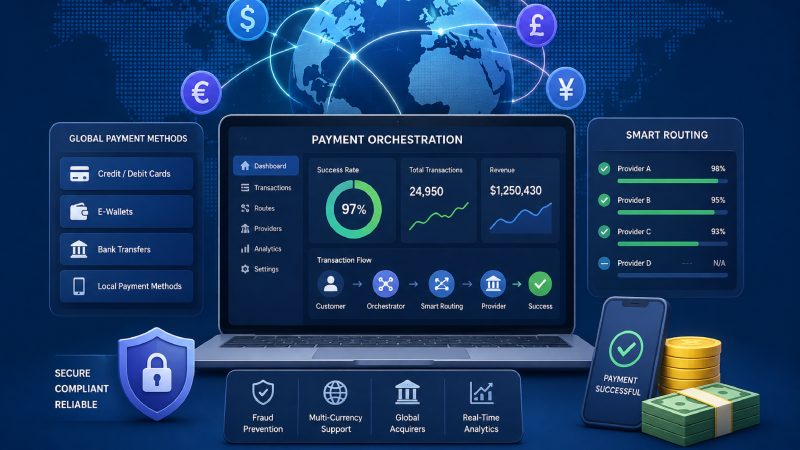
At its core, a payment orchestration platform acts as an intelligent middleware layer connecting a merchant’s checkout system to a vast network of acquirers, alternative payment methods (APMs), and fraud prevention tools through a single API.
Instead of hardcoding individual integrations for every new region, businesses plug into an orchestration platform that automates the entire transaction lifecycle. When a customer initiates a purchase, the system evaluates parameters such as geographic location, currency type, cost, and historical success rates. It then routes the transaction through the optimal path in real time. If a primary acquiring bank encounters downtime or declines a valid transaction due to routing quirks, smart fallback mechanisms instantly reroute the payment to an alternative provider, preserving the sale.
3. Core Pillars of an Advanced Global Payment Engine
Deploying a comprehensive orchestration framework delivers transformative operational advantages across multiple dimensions of digital commerce:
- Maximized Authorization Rates: Intelligent routing algorithms dynamically select the most reliable acquiring bank for a given transaction, minimizing false declines and boosting overall checkout success.
- Localized Checkout Experiences: Businesses can effortlessly present buyers with over 170 preferred local payment options and dozens of currencies, significantly reducing cart abandonment.
- Streamlined Multi-Currency Payouts: Orchestration platforms extend beyond consumer checkout to handle complex vendor disbursements, supplier payouts, and creator earnings across global markets.
- Integrated Risk and Compliance Management: Advanced AI-driven risk engines analyze transaction patterns in real time, screening for fraud while maintaining compliance with local financial regulations across multiple jurisdictions.
4. Transforming Marketplaces, SaaS, and Enterprise Workflows
Different business models require tailored financial architectures. For multi-vendor marketplaces, payment orchestration simplifies split payments, automatic commission deductions, and instant payouts to international sellers. Rather than navigating manual reconciliations, marketplace operators can orchestrate complex fund flows from a unified dashboard.
Similarly, software-as-a-service (SaaS) providers and digital economy platforms leverage modular APIs to embed financial services directly into their ecosystems. By utilizing unified infrastructure providers like ONERWAY, businesses can scale past legacy limitations, replacing multiple isolated vendor relationships with a single, highly resilient engine designed for global growth.
Frequently Asked Questions (FAQs)
What is the primary difference between a payment gateway and payment orchestration?
A traditional payment gateway connects a website to a single acquiring bank to process a transaction. In contrast, a payment orchestration platform sits above multiple gateways, acquirers, and alternative payment methods, using smart routing and automated rules to direct transactions through the most efficient channel while offering a unified dashboard for management.
How does smart routing improve transaction success rates?
Smart routing analyzes variables such as the customer’s geographic location, card issuer, currency, and historical uptime performance. If a primary payment processor experiences technical issues or a temporary decline, the orchestration engine instantly reroutes the transaction to an alternative backup provider, preventing a lost sale.
Can payment orchestration platforms handle multi-currency payouts to suppliers?
Yes. Modern orchestration ecosystems manage both inbound consumer collections and outbound disbursements. They allow businesses to hold multi-currency balances and disburse funds to overseas suppliers, logistics partners, and freelance contributors across dozens of countries quickly and cost-effectively.
Is payment orchestration suitable for small businesses or only large enterprises?
While enterprise corporations with high-volume cross-border traffic benefit immediately, small and mid-sized ecommerce brands, marketplaces, and digital platforms also utilize orchestration layers to scale internationally. Pre-built plugins for popular content management systems and e-commerce frameworks make implementation accessible without requiring massive engineering overhauls.
Conclusion
The evolution of digital commerce demands infrastructure that is as dynamic and borderless as the internet itself. Traditional, siloed payment gateways are no longer sufficient for companies aiming to capture global market share efficiently. By adopting a robust payment orchestration strategy, businesses can eliminate checkout friction, optimize routing costs, and secure complex cross-border fund flows. Embracing this unified approach empowers organizations to focus on core product innovation and global expansion while automated systems handle the complexities of worldwide transactions.
For more information, visit our site daily.