
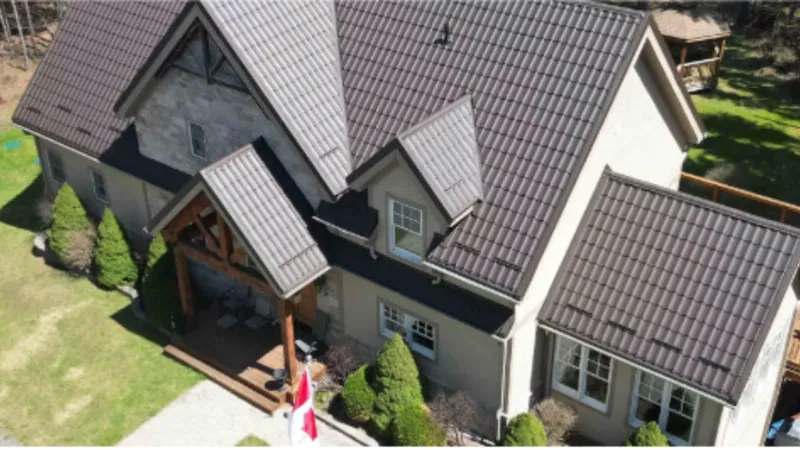
A roof quote looks like a single number. It works more like a long-term subscription. The material on top of a house decides how often the owner pays for a tear-off, which repairs show up after storms, and how buyers react years later. Here is how the common options compare.
Lifespan Is Where the Real Price Hides
Home inspector charts give a standard three-tab asphalt shingle roof about 20 years. Thicker architectural shingles often stretch to 25 or 30. Metal sits at 40 to 80 years on the same charts, while the metal industry’s own trade group says 40 to 70. Even that cautious low end doubles a basic shingle roof.
Picture a family keeping one house for 40 years. With asphalt, they will likely pay for at least one replacement, and hauling away the old layer alone runs roughly $1,000 to $5,000. The US generates an estimated 15 million tons of asphalt shingle waste a year. That is a lot of driveway dumpsters.
Steel panels only reach those extra decades if everything under them lasts as long. A professionally installed metal roof holds its value through details most owners never see, from underlayment and ventilation to flashing around chimneys. When a crew gets those layers right, the roof has a fair shot at the upper numbers.
What Buyers and Appraisers Notice
Appraisers do not add the roofing invoice to a home’s value. They look at condition and at how many years the roof has left. FHA loans in the US generally cannot close on a house whose roof has under two years of life left. A tired roof can quietly shrink the buyer pool.
Agents love quoting one annual remodeling survey. In 2025, it put resale payback at about 68% of the cost for a new asphalt roof and near 50% for metal, with both figures a bit lower in 2023. So asphalt wins? Mostly for an owner who sells soon after the crew packs up.
An owner who stays 20 years sees a different picture. By then, an asphalt roof is nearing the end of its expected life, and inspectors notice. Buyers commonly ask for $5,000 to $15,000 in credits over a worn roof, and 37% of agents in a 2025 Realtor survey recommend a new roof before listing. Hard to argue.
Good records make any roof easier to sell. A buyer can check a claim on paper far faster than on a ladder, and paperwork proves how much life a roof has left. Sellers do best when they can hand over:
- The installation date and the installer’s name
- Transferable workmanship warranty papers
- Photos from completion day, taken before snow and leaves hide the edges
Maintenance Costs by Material
Owners feel the gap between materials in upkeep. Some roofs call for a repair crew after every rough winter, while others rarely cross anyone’s mind. Material by material, the pattern usually looks like this:
- Asphalt shingles curl, crack, and shed granules with age. A localized storm repair typically costs between $400 and $2,000.
- Moss loves cedar shake in shady corners, and owners book professional cleaning and treatment every few years.
- Clay tile brings two cold-climate headaches: roughly 8 to 12 pounds per square foot and a porous body that can crack when trapped water freezes.
- On a steel standing seam or metal tile roof, owners mostly check things after big storms, since the nonporous panels shrug off freeze cycles and weigh about 1 to 1.5 pounds per square foot.
Paint matters more than people expect. Silicone-modified polyester, or SMP, usually holds its color for 10 to 15 years before fading and chalking set in, while premium PVDF systems resist sunlight far longer and carry 40-year finish warranties with defined fade limits. Sounds nerdy. It decides whether the roof looks tired at year 15.
Matching the Roof to Your Timeline
Start with one honest question: how many winters will you spend under this roof? If a move is likely soon, aim for a roof that looks sound to the next buyer. If you plan to stay for decades, rank lifespan and upkeep above the day-one quote.
American homeowners took their time with metal. In 1998, it went on to fewer than 4% of US reroofing jobs, and by 2023 it covered around 17 to 18% of the residential market, though survey methods changed along the way. Nearly a fivefold jump. Before signing, compare quotes line by line and check:
- Which profile suits the house: standing seam for clean lines, steel tile for a traditional look
- A clear plan for snow retention over doors and walkways
- Tear-off, disposal, and cleanup, and whether the price covers them
- A roof matched to your real timeline rarely feels expensive ten years in.
For more informative articles, visit our site daily.